
Why Ceiling Height Changes Your Acoustic Strategy
Two offices can have the same floor area, the same number of people and even similar finishes, but sound completely different.
One reason is surprisingly easy to overlook: ceiling height.
We tend to think about ceiling height visually. Higher ceilings can make a workplace feel more open and impressive, while lower ceilings can create a more intimate feel. But changing the height also changes the volume of the room and the way sound behaves within it.
And that can completely change the acoustic strategy.
When we talk about room acoustics, one of the things we’re trying to control is reverberation. This is the build-up of reflected sound within a space. Reverberation time, often referred to as RT60, measures how long it takes for that sound level to dissipate by 60 decibels after the original sound has stopped.
Think about the difference between having a conversation in a small furnished room and having the same conversation in a large empty hall. You haven’t suddenly started speaking differently. The space around you has changed.
The relationship between room size and reverberation has actually been understood for well over a century. American physicist Wallace Clement Sabine established that reverberation time is related to the volume of a room and the amount of sound absorption within it. In simple terms, as room volume increases, more absorption is generally needed to achieve the same reverberation time.
To put that into perspective, imagine a 10m x 10m office. With a 2.5m ceiling, the room volume is 250m³. Increase that ceiling to 5m and the volume doubles to 500m³, despite the floor area remaining exactly the same.
That doesn’t mean the room will automatically be twice as reverberant. Furniture, finishes, people and the amount and position of acoustic absorption all influence the result. But it does show why an acoustic strategy designed for one ceiling height shouldn’t simply be copied into another.
And it isn’t always as straightforward as saying a higher ceiling needs more acoustic treatment.
Where that treatment sits matters too.

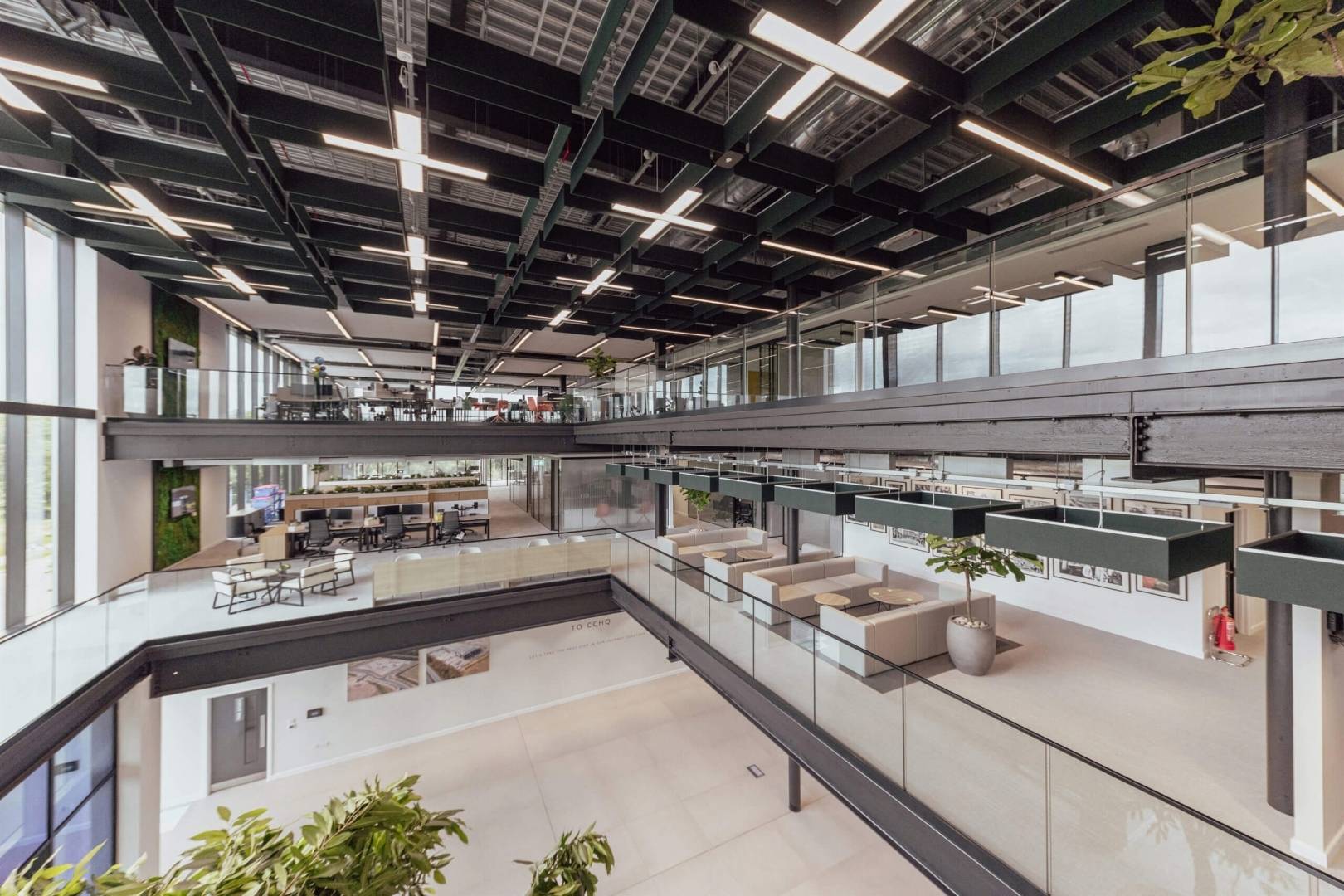
Take suspended acoustic rafts or baffles. In a high ceiling space, bringing acoustic treatment down from the soffit can position absorption closer to the occupied area, while still retaining the height and character of the space.
Research has shown that placement can make a difference too. A 2019 study published in Acoustics investigated how the location of sound absorbing materials affected reverberation time and found measurable differences when absorption was repositioned within the same room.
So, the question shouldn’t simply be, “How many acoustic panels do we need?”
It should also be, “Where are they going to work hardest?”
Lower ceilings bring a different challenge.
There is less physical room to play with, so large suspended features might not always make sense. Acoustic treatment that sits closer to the soffit or integrates more tightly with the ceiling system may be more appropriate.
Higher ceilings give designers more freedom to work vertically, using suspended baffles or rafts at different heights to bring acoustic absorption into the space without losing the openness above.
This becomes particularly important with the open ceiling aesthetic we see in so many workplaces.
Exposed services, concrete soffits and large open volumes can look brilliant, but removing a traditional suspended ceiling can also remove a significant area of potential sound absorption.
The UK Government Property Agency’s workplace design guidance specifically states that additional acoustic absorption is required where exposed soffits are used. In other words, keeping the ceiling open doesn’t remove the need to think about acoustics. It makes planning the acoustic strategy even more important.
The answer isn’t to abandon the open ceiling. It is to design the acoustics around it.
Baffles can introduce absorption without hiding the soffit. Rafts can target specific areas below, while different heights, sizes and layouts can become part of the design itself rather than feeling like something added afterwards.
There is another interesting factor to consider when suspending acoustic treatment: the air gap behind it.
Studies into porous sound absorbers have shown that leaving an air gap between an absorber and the solid surface behind it can improve sound absorption at certain frequencies. A 2021 review published in Acoustics Australia found that air cavities behind porous absorbers can be used to improve their low frequency absorption, although performance depends on the material, depth and frequency being considered.

So, the space above a suspended acoustic feature isn’t necessarily wasted space. Its suspension height can form part of the acoustic design too.
All of this is why there isn’t a magic ceiling height where the acoustic strategy suddenly changes, or one ceiling layout that can simply be repeated across every project.
Instead, start with the room.
How high is the ceiling? What is the overall volume? What are the surrounding surfaces made from? How many people will use it? What will they be doing there? And where will most of the noise be generated?
Then think about where absorption will have the greatest impact.
A lower ceiling might lend itself to acoustic treatment sitting close to or within the ceiling plane. A tall open space might benefit from suspended baffles or rafts positioned within the larger volume. And particularly large or reverberant spaces may need absorption across both ceilings and walls rather than asking one surface to do all the work.
Ceiling height might seem like a simple architectural decision, but acoustically, it changes much more than the distance above your head.
It changes the volume of the room, influences reverberation and affects how and where acoustic treatment can be used.
So next time you’re looking up at a ceiling and thinking about what to do with it, don’t just think about how it looks.
Think about what that height means for the sound below it.
Take a look at our range of acoustic ceiling solutions, with options to suit spaces with both high and low ceilings!
Want to explore acoustic solutions that are tailored to your next design project? Take a look at our full range of acoustic solutions here or give us a call on +44 (0)20 3889 9888, email us at hello@allsfar.com or fill in our contact form on our website here.
Vous souhaitez découvrir des solutions acoustiques adaptées à votre prochain projet de conception ? Consultez notre gamme complète de solutions acoustiques ici ou contactez-nous au +33 (0)1 89 71 41 60, envoyez-nous un mail à contact@allsfar.com ou remplissez notre formulaire de contact sur notre site web ici.
Keep In Touch
Sign up to our newsletter and find out about our latest products, new projects and showroom events.
Rester en contact
Inscrivez-vous à notre newsletter et découvrez nos derniers produits, nos nouveaux projets et les événements organisés dans nos showrooms.

Products
Contact
T: +44 (0)20 3889 9888
AllSfär © 2026
Produits
Liens
Contact
Paris | St Etienne | Alès