

Noise pollution in open-plan offices: Regulations, standards and solutions for France
When we think about workplace noise regulations, we often associate them with industrial environments. However, employers also have legal obligations to manage noise levels in office settings. This includes taking collective or individual protective measures where necessary. A regulatory framework and recognised standards do exist for office environments—particularly for open-plan offices—to help ensure acceptable acoustic conditions.
From prevention to the regulatory framework
When it comes to prevention, whether for acoustic comfort or psychosocial risks, the regulatory framework is the same. Article L. 4121-2 of the French Labor Code sets out the general principles of occupational risk prevention and the employer’s obligations, which are:
• Avoid the risks;
• Assess the risks that cannot be avoided;
• Combating risks at their source;
• To act on the conditions and organization of work;
• To train and inform employees about risks and their prevention;
• Take collective protection measures, giving them priority over individual protection measures.
It is European Directive 2003/10/EC, transposed into French law by Decree 2006-892 of September 19, 200 , and the Order of July 19, 2006, that sets the occupational noise exposure thresholds;
1. 80 dB(A) and 135 dB(C) correspond to the lower exposure level that should trigger preventive action.
2. 85 dB(A) and 137 dB(C) represent the upper exposure levels that should trigger corrective action.
3. 87 dB(A) and 140 dB(C) are considered exposure limits (values that take into account the attenuation due to wearing personal hearing protection). These limits must never be exceeded.
The assessment of noise-related risks therefore involves an evaluation noise, some more tolerable than others. Up to 50 decibels or dB(A), there is no health risk, given that 20 decibels or dB(A) is the threshold for perceiving light noise and 50 dB(A) is the noise level of a normal conversation.
From regulation to standard
The AFNOR S31-199 standard was created to optimize the acoustic environment of open-plan offices and to support companies wishing to address this issue. Unlike very strict industrial noise regulations, it is not mandatory.
It issues recommendations to ensure a certain level of acoustic comfort in open-plan offices. Four main types of activities have been identified:
Telephone activities: average noise level between 48 and 52 dB.
Activities based on collaborative work: average noise level between 45 and 50 dB.
Activities based on low levels of collaboration: average noise between 40 and 45 dB.
Activities involving public reception services: average noise level below 55 dB.
This acoustic standard also proposes a methodology, a procedure , and concrete actions to be taken. It provides support materials for conducting employee surveys and rules for communal living in open-plan offices.
From regulatory requirements to well-being and productivity
Even though ambient noise in an open-plan office is generally below the 60 dB alert threshold, noise pollution is a reality that affects everyone’s comfort, concentration, and performance. We have already had the opportunity to highlight this , particularly through an IFOP study conducted in 2019 .
While regulations concerning noise in the workplace are designed to ensure the safety and health of employees , they also contribute to their well-being and productivity . Therefore, offices and common areas must be properly soundproofed, and noise levels must be clearly defined to avoid impairing the intelligibility of conversations. Noise pollution in the workplace must also be reduced by addressing reverberation time (the space’s response to noise).
The solutions lie in the areas of layout and collective noise protection (walls, ceilings, acoustic panels, etc.). A dedicated quiet space can also be considered, such as a room for employees needing to rest or a dedicated area where they can make phone calls or… unwind (chat, discuss, have a coffee, etc.).
These are generally simple solutions to implement and do not require major work. They will quickly prove effective… provided you work with an acoustics professional who will know what improvements to make depending on the layout of the premises and the activity.
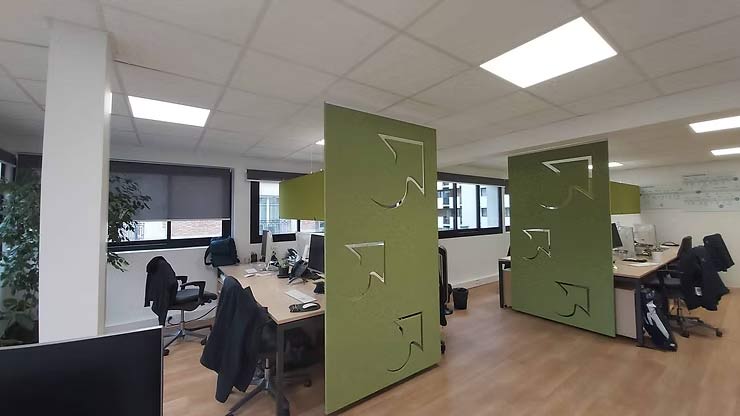
From workspace to living space
Today, the workspace is undergoing a new evolution, directly in line with our digital transition and the rise of flexible offices. Habits are changing (remote work, collaborative work, mobility, etc.), and so are needs . The office must reinvent itself to offer optimal flexibility in space and time. Living spaces are expanding and are no longer considered wasted space. The open-plan office remains the preferred format for collaborative work, but it has become essential to adapt it. Balancing the need for privacy with the necessity of better noise management, it is complemented by various amenities.
me spaces reserved for meetings, telephone calls, relaxation, etc.
The office has become a dynamic space, a place to work but also to live, making it an attractive place to be (just look at the limitations of remote work following the various lockdowns). And, for companies, this new approach also allows them to value the workspace as an asset for attracting and retaining young talent.
Dynamic spaces today are therefore large, open areas where noise reverberates. But this nuisance is not inevitable. Design options exist, and soundproofing is easily managed. Provided, of course, that the right solutions are chosen so that the office becomes both a workspace and a living space, a pleasant place to be.
Want to explore acoustic solutions that are tailored to your next design project? Take a look at our full range of acoustic solutions here or give us a call on +44 (0)20 3889 9888, email us at hello@allsfar.com or fill in our contact form on our website here.
Vous souhaitez découvrir des solutions acoustiques adaptées à votre prochain projet de conception ? Consultez notre gamme complète de solutions acoustiques ici ou contactez-nous au +33 (0)1 89 71 41 60, envoyez-nous un mail à contact@allsfar.com ou remplissez notre formulaire de contact sur notre site web ici.
Keep In Touch
Sign up to our newsletter and find out about our latest products, new projects and showroom events.
Rester en contact
Inscrivez-vous à notre newsletter et découvrez nos derniers produits, nos nouveaux projets et les événements organisés dans nos showrooms.

Products
Contact
T: +44 (0)20 3889 9888
AllSfär © 2026
Produits
Liens
Contact
Paris | St Etienne | Alès